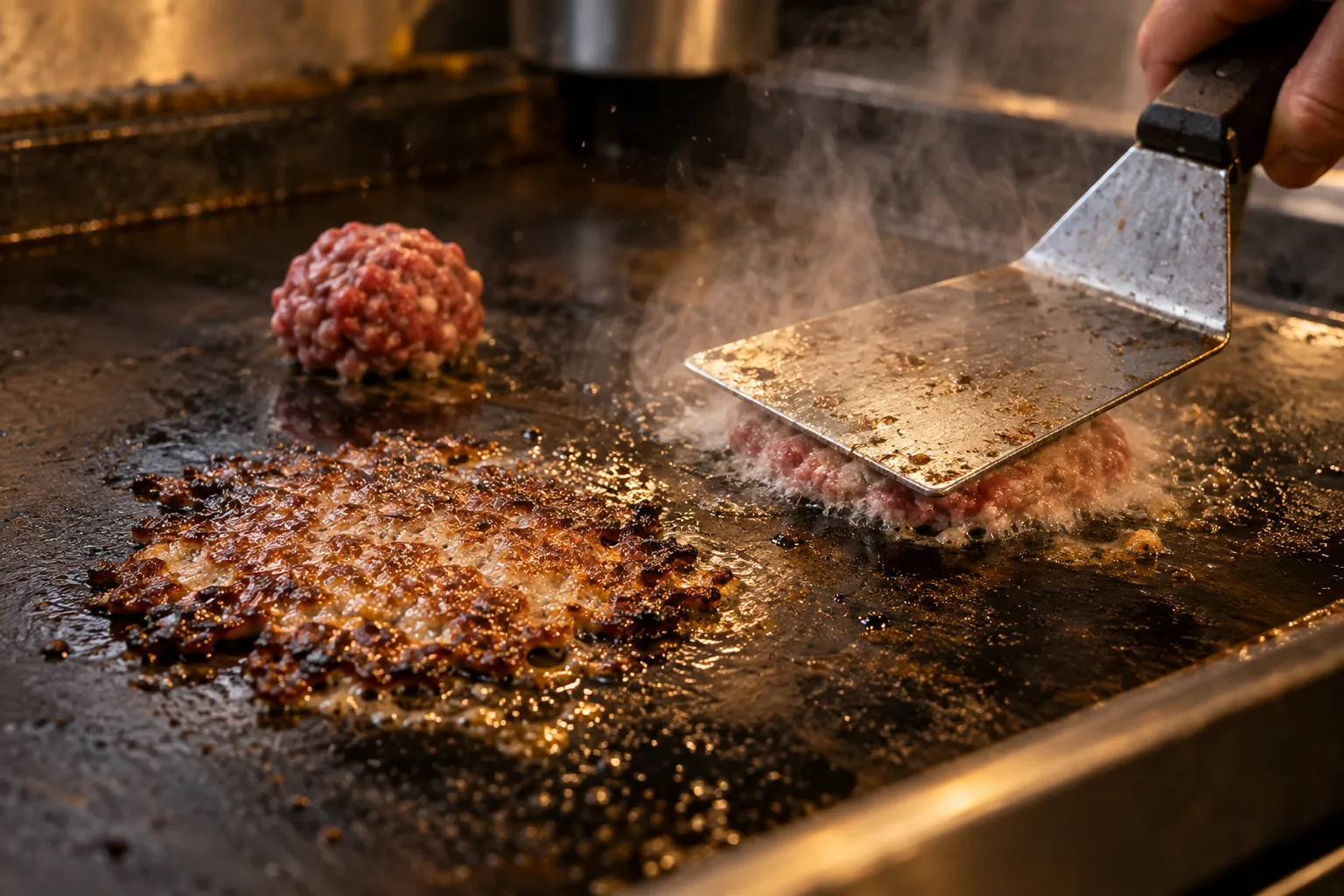
Smash burgers are easy until they are not. One minute you are picturing crispy edges and melted cheese. Ten minutes later you are staring at gray beef on a bun, pretending it was supposed to be rustic. I have been there. It is not a proud place.
Quick take: Avoid the most common smash burger mistakes, from a cold pan to late smashing, weak spatulas, wet toppings, and buns that fall apart.
Mistake 1: The Pan Is Not Hot Enough
This is the big one. If the beef does not sizzle hard the second it touches the pan, you are not making a smash burger yet. You are making a thin hamburger with confidence issues.
A hot pan creates fast browning. A warm pan steams the beef first, and steam is not your friend here. The crust comes from contact between beef and hot metal. If the metal is not hot, the meat gives off moisture before it can brown.
Preheat longer than you think. Cast iron takes time. A flat-top takes time too. Give the surface a real chance to heat up before you start cooking.
Mistake 2: Smashing Too Late
You need to smash right away. Once the beef starts cooking, the proteins set. If you press after that, you are not creating more crust. You are squeezing out juice and tearing what little crust already formed.
Serious Eats explains that the smash works because it increases contact with the griddle and boosts browning. That contact has to happen early. Waiting is where things go sideways.
Have the parchment and press ready before the beef hits the pan. Do not drop the beef and then go digging through a drawer. The burger clock starts immediately.
Mistake 3: Using the Wrong Tool
A flexible fish spatula is nice for fish. It is not the best smash tool. You need something stiff, flat, and wide enough to press the beef evenly.
A burger press works. A heavy metal spatula works. A small cast iron pan can work if you have parchment between the pan and the beef. The goal is even pressure. If the tool bends, the middle may smash while the edges stay thick.
For flipping, thin and stiff is the sweet spot. You have to scrape under the crust. If your spatula slides over the browned bits and leaves them on the pan, you just donated the best part of dinner to your cookware.
Mistake 4: Moving the Patty Around
After the smash, leave it alone. Do not poke. Do not scoot. Do not lift one edge every five seconds like the burger is hiding a secret.
The first side needs time to build crust. That does not mean a long time. It may be less than a minute. But it does need stillness. The burger will tell you when it is close. The edges will brown, the top will start to look cooked around the rim, and the smell will shift from raw beef to diner magic.
Then scrape, flip, cheese, and move fast.
Mistake 5: Overloading the Burger
A smash burger is thin. That is the point. If you pile it with thick tomato, too much lettuce, four sauces, and an onion ring, the patty disappears. Now you have a salad sandwich with beef somewhere in the paperwork.
Keep toppings thin and sharp. Pickles, shaved onion, a little lettuce, and sauce are enough. If you want tomato, use a good one and slice it thin. Bad tomato adds water and sadness.
The sauce should help, not flood. A thin layer on each bun is plenty.
Mistake 6: Ignoring the Bun
The bun is not just a handle. It is part of the burger. A soft potato roll is the easiest win because it compresses with the patties and does not fight the bite.
Toast the cut sides. This adds flavor and helps the bun stand up to sauce and beef fat. You can toast in a pan with butter, mayo, or a little of the beef fat left on the griddle.
If the bun is too tall, the burger feels off. Smash burgers are about balance. You should taste beef, cheese, sauce, pickle, and bun in one bite.
Mistake 7: Forgetting Carryover Heat
Smash burgers are thin, but they still keep cooking for a short time after they leave the pan. If you cook the second side until it looks totally done and then let the patty sit while you toast buns, you may end up with a dry burger.
This is why setup matters. Toast buns first or toast them on the side while the first batch cooks. Have cheese ready. Have sauce ready. Once the patty flips, you are close to the finish line.
The second side should be quick. Think melt the cheese, finish the meat, and get out. This is not a steak where you are waiting around for a deep internal gradient. It is thin beef. It gets the message quickly.
Mistake 8: Treating Every Pan the Same
Cast iron, stainless steel, carbon steel, and flat-top griddles all behave a little differently. Cast iron holds heat well but takes time to preheat. Stainless heats faster but can have hot spots. Carbon steel is great once seasoned, but thin pans can cool down fast when beef hits them.
The fix is to cook a test patty. Make one small patty first and see what happens. If it browns too slowly, wait longer or raise the heat. If it burns before the cheese melts, back the heat down a touch.
That test patty is not waste. It is the cook snack. Very important quality control.
Mistake 9: Using Cold Toppings on a Hot Burger
Cold toppings are fine in small amounts, but a smash burger is thin. If you bury it under refrigerator-cold tomato, cold sauce, and a mountain of lettuce, the whole burger cools down fast.
Let sauce sit out while you cook, and keep toppings simple. Pickles and onions can be cool because they are thin and sharp. A huge cold tomato slice is different. It can turn a hot burger lukewarm before you make it to the table.
This is another reason diners keep the build simple. The burger comes off the griddle hot, gets cheese, gets a few toppings, and goes straight out. That speed is part of why it works.
The Bottom Line
Most smash burger mistakes come from rushing the setup and then fussing too much during the cook. Get everything ready first, heat the pan hard, smash right away, and then leave it alone.
The burger does not need you to be fancy. It needs you to be ready.
Quick Questions
Why did my smash burger not get crispy?
The pan was likely not hot enough, or the patty moved before the crust formed.
Can you smash a burger more than once?
No. Smash once at the start. Pressing later can squeeze out juices and damage the crust.
Why does my smash burger stick?
Some sticking is normal. Use a thin, stiff spatula to scrape under the crust instead of lifting gently.